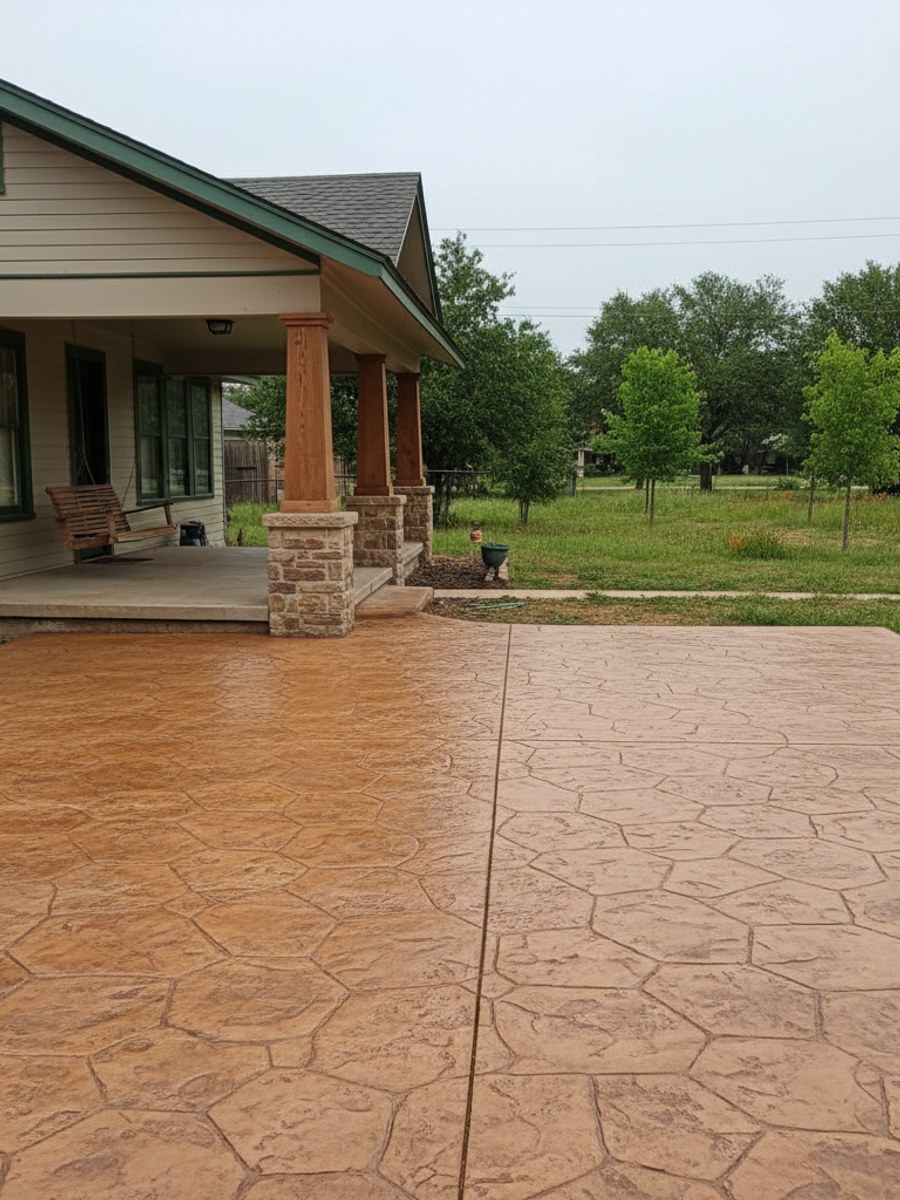
Concrete looks simple once it's poured and gray and flat. Picking who pours it is where most of the mistakes get made, and they don't show up until eighteen months later when a driveway heaves or a patio slab cracks corner to corner. This is what actually separates a contractor worth hiring from one who's going to leave you a problem.
Start with the ground, not the price
San Angelo sits on a lot of expansive clay, especially west and north of downtown, with caliche layers mixed in depending on the lot. Clay swells when it's wet and shrinks hard when it dries out, and this part of Texas swings between the two. A slab poured on unprepared clay will crack along whatever line the soil decides to move on, not the line you cut for it. Ask any contractor what they do to the base before they pour. The honest answer involves compacted road base, usually 4 to 6 inches, sometimes a moisture barrier under a foundation slab. If the answer is "we just pour on what's there," that's a walk-away.
A contractor who's worked here for any length of time will also ask about your specific lot before quoting a number over the phone. Soil on an older lot near Lake View or Bowie can behave differently than a new pad in a subdivision off Southwest Boulevard where the fill dirt was brought in during grading. That's not a detail a generic bid sheet accounts for.
What should be in a real bid
A driveway bid that's a single line item, "concrete driveway, $X," tells you nothing. A proper bid names the thickness (4 inches for a walkway or patio, 5 to 6 for a driveway that'll take a truck), the PSI of the mix (3,000 PSI is standard for flatwork here, 3,500 to 4,000 if you want more durability against our freeze-thaw swings), and whether it's reinforced with rebar or wire mesh. Rebar, usually #3 or #4 bar on an 18-inch grid, holds a slab together better if the ground shifts under it, which matters more here than in places with stable soil. Mesh is cheaper and fine for lighter loads, but a contractor should tell you which one you're getting and why, not leave it out of the paperwork entirely.
The bid should also say where the control joints go. Joints get saw-cut within the first 24 hours after the pour, spaced roughly 2 to 3 times the slab's thickness in feet, so a 4-inch slab gets joints every 8 to 12 feet. That's how you tell the concrete where to crack instead of letting it pick its own spot down the middle of your driveway.
Weather is not a footnote here
Concrete cures by a chemical reaction, not by drying out, and San Angelo's summer heat works against that. In July and August, slab temperatures on a sunny pour can climb well past what the mix wants, and the surface can set faster than the water underneath can hydrate the cement properly. That leads to plastic shrinkage cracks, the thin surface cracks that show up within hours of finishing. A crew that knows what they're doing will pour early morning in summer, mist the surface, and get a curing compound or wet burlap down fast. If a contractor doesn't mention any of that and wants to pour a driveway at 2pm in August, that's worth pushing back on.
Winter isn't a big freeze-thaw problem here compared to further north, but we do get enough nights below freezing between December and February that a pour timed badly can suffer surface scaling if it's not protected while curing. Either extreme needs a plan, not a shrug.
Permits, insurance, and who's actually doing the work
Inside San Angelo city limits, most new driveways, slabs, and foundation work need a permit through the city, and if you're outside city limits in Tom Green County the requirements can be different, so ask which one applies to your address before assuming. A legitimate contractor pulls the permit themselves or tells you plainly that you need to. If someone tells you not to bother with a permit to save time or money, understand that decision falls on you later, not them, especially if you ever sell the house and it comes up in an inspection.
Ask for proof of general liability insurance and, if they have employees, workers' comp coverage. A slab pour involves a concrete truck, a pump sometimes, and several guys with finishing tools working fast against a setting clock. Accidents happen. You don't want your homeowner's policy covering it because the contractor didn't carry their own.
Also ask who's on the crew the day of the pour. Some outfits sell the job, then hand the actual pour to a sub-crew you've never met. That's not automatically bad, but you should know it going in, and you should know whether the person who quoted you is the person who'll be there checking slump and float times.
Red flags worth walking away from
- Full payment demanded upfront, before any material shows up. A deposit is normal. All of it, before a truck arrives, is not.
- No mention of rebar, mesh, or joint spacing anywhere in the written quote.
- A price that's dramatically lower than two or three other bids for the same square footage and thickness. Concrete, labor, and fuel for the mixer truck cost roughly the same for everyone in this market. A big gap usually means a thinner slab, no reinforcement, or a crew that's going to cut something you won't see until the concrete's already down.
- No physical work you can go look at. Ask for addresses of jobs they've done in the last year or two, drive by, and look at how the joints have held up and whether the surface is spalling or pitting.
- Reluctance to put the cure time in writing. Light foot traffic is usually fine after about 24 to 48 hours. Driving a car on it wants at least 7 days. Full strength takes 28 days, and a contractor should tell you that without being asked.
What a good relationship with a contractor looks like
You should be able to ask dumb questions and get a straight answer. What's the slump of the mix. Why 4 inches here and 6 there. Why is the base different on this side of the yard. A contractor who's been pouring concrete around expansive clay soil for years has opinions about all of it, and they'll tell you even the parts that don't make the job sound easy, like the fact that no amount of rebar stops a slab from cracking eventually, it just holds the pieces together when it does.
We've done driveways, patios, foundations, and repair work across San Angelo and the towns around it long enough to know which lots give us trouble and which don't. If you're getting bids right now, ask the questions above before you ask about price. The price only matters once you know what you're actually paying for.